

The Eden Cycle, a review

From the back of the book:
A Gift From The Stars. As you choose in all matters, you have ultimate free choice, as long as you do not seriously interfere with the choices of other roving personalities...
A superior alien intelligence rules over Earth with absolute benevolence and total control. It offers man a future with no seeming limit to time or space- or reality. Any man can have anything he is capable of wanting, forever.
Does man really want absolute free will- and what will he do with it?
Has this noble plan gone sour?
What is the future of mankind-if, indeed, it has a future?
I honestly don't remember where I got this book. Recently, we were going through some old bins of belongings (the never-ending cycle of downsizing is upon us) and I found this tucked in with some well-loved novels. I had never read it. I don't remember buying it. A glitch in the simulation? Maybe!
The Eden Cycle is a peculiar story that feels particularly poignant for our times. I'm not a cause reader, as in, let's read this book to better understand a real-life cause. I'm a dyed-in-the-wool escape reader. Causes are for my real life, and I try to keep them there. However, in the larger conversation about AI currently going on in our real world, this book was an interesting perspective.
The main character is Joey (though he earns numerous names, this is the one he keeps coming back to). He lives inside a simulation. He doesn't know it at first. In fact, he might never have known it, or admitted to it, if it weren't for the other significant character, Jennie. Together, they learn how to break out of the simulation sequence they are in, the one they remember most and first. From there, they rove through history and space, trying on lives like you might try on a costume. Each "sequence" comes with its own history, memories, facts, which they can access at will. But when the reality of those sequences become too real-feeling, or too boring, they can "wake up" and leave.
Not everyone can do this. They interact with loads of people, with no real knowledge if those people are real but not yet "awake," or if they are just another prop of the simulation. That includes their parents, their children, everyone. Eventually Joey and Jennie meet some real people, folks who know about the simulation and how to manipulate it.
The central conflict of the story is how meaningless everything is once you know it isn't real. And it would be, wouldn't it? They attempt all sorts of lives, ones chasing causes, ones chasing familial bliss, artistic accomplishments, scientific endeavors... But they all lose their thrill, their sense of fulfillment because at the end of the day, none of it is real.
The Eden Cycle was published in 1974. As such, the author, Raymond Z. Gallun, does not have our current technological vocabulary for some the concepts he is introducing in the story. For instance, there is a bit of a struggle for what to call the individuals that are not real, just part of the simulation. I imagine a modern writer would pull from video game language and call them "NPCs." Most would know automatically what that meant. Not in 1974 though!
Another aspect I found interesting was how completely submerged the individuals were in their augmented realities. No futuristic goggles strapped to prone bodies. No chunky button or fat dials to turn. There aren't even the more modern isekai-ish screen menus or heads-up displays. The individuals travel between sequences by wishing. Nothing else.
Eventually the characters decide to ask about their real bodies. Joey doesn't even have one. His consciousness is entirely contained inside a little nodule that emits electrical signals. Jennie, however, has a real body. It is unimaginably old. Gallun imagined that this simulated reality is created sometime in our current century after an interesting meeting with alien life. The superior intelligence then gifts the entire system to Earth as a way to bypass war, cruelty, want, prejudice, and all other manner of sins. After all, who can you hurt if you are alone in a simulation of your own wishing?
What is the motivation to improve without others around you? If your actions have no impact on another soul, do any of your actions matter at all?
Jennie and Joey are eventually compelled to leave the simulation altogether. They chose a real life in the real world, accepting the difficulties and the inevitability of their own death. Anything to matter in the world, to leave a mark that tells the future that they really lived. Their alien benefactors are happy to provide them with a body, transportation, and anything else they might need or want, including re-entry into the simulation.
I'm, personally, savagely against AI. I think a book like this asks questions that we need to ask as well. Just because a machine can do something for us, should it? Throughout history, we have invented to make our lives better, or at least easier. More convenient. While AI can make some things more convenient, in my opinion, the cost is too high. It takes away from people things they still need for the betterment of their own human condition. Without the difficulty of accomplishing something, it doesn't mean anything. Joey and Jennie ultimately choose to live life in the rough, facing wild animals, injuries, illnesses, and the elements just to have meaning in their life. Will we have to make similarly extreme choices one day to give our own lives meaning? And if so, will you or I have the mettle of Joey and Jennie to choose the harder path? Or will we stay in the simulation?
In my usual research for this review, I tried looking into the author, Raymond Z. Gallun. I didn't recognize his name. Imagine my surprise to find that he was an extremely influential science fiction short story writer in the the 1930s and 40s! His work was frequently featured in the popular science fiction magazines of that era. Later he published some stand alone novels, including The Eden Cycle. He showed a particularly unique interest in genetic engineering and biology in his works, which influenced other writers of his time and later. I can honestly say that there were aspects of the science part of The Eden Cycle that surprised me for the age of the novel.
But how influential could he be if no one has heard of him now? Well, there's a science fiction award named after him in Long Island. Del Rey thought he was good enough to release a "Best of" collection of his works. He has 17 books free for downloading on Project Gutenberg. Somewhere, there are people who remember his name, and for that I'm glad.
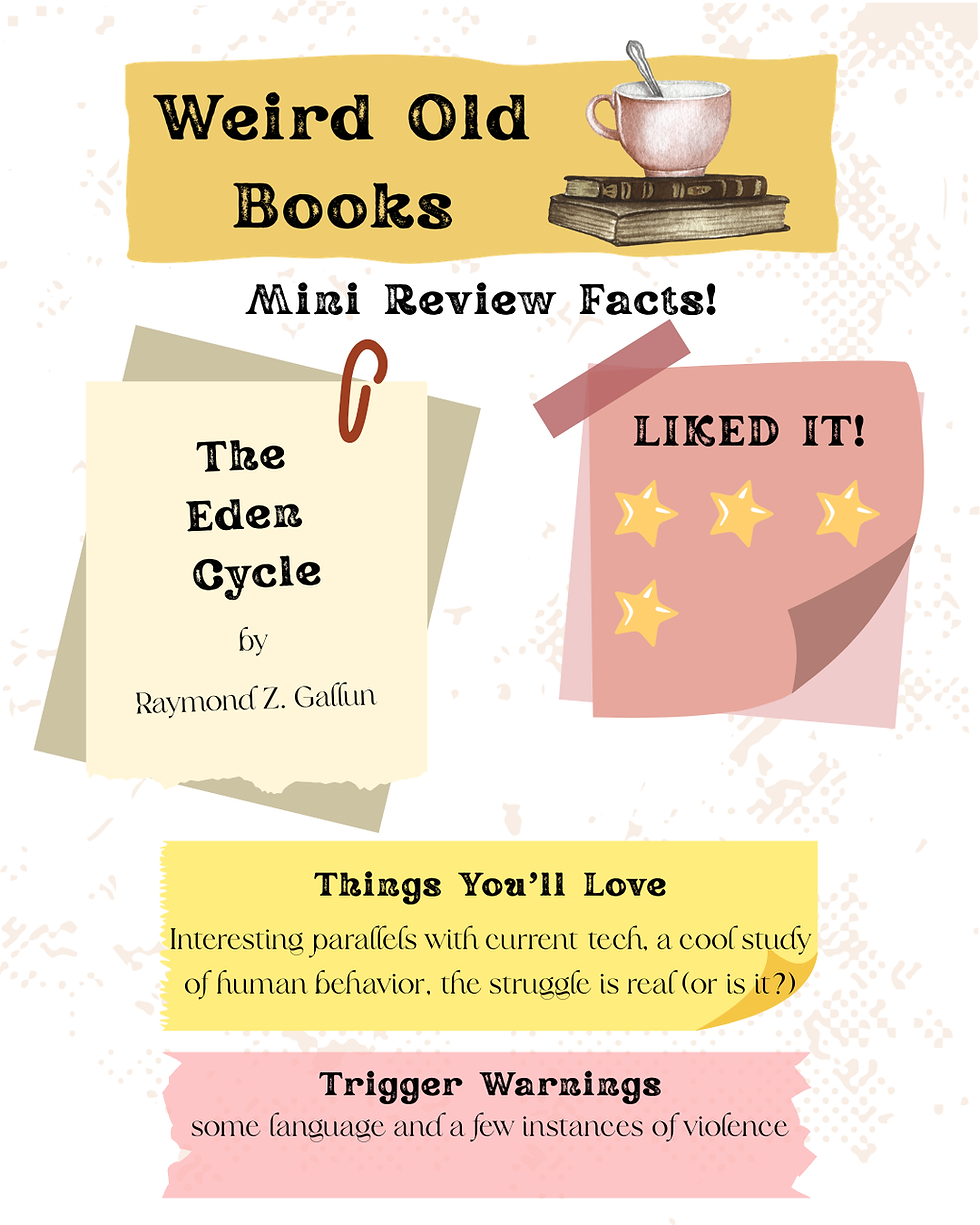
The Eden Cycle is a really interesting read. It gets a bit slow in the middle (it took Joey and Jennie a lot longer to get bored with their simulations than it took me to). Otherwise, I found it to be well-written, well-thought out, and a nice break from more current trendy writing. It doesn't follow the normal story arc that we are used to, or maybe it is only that the pacing is different. Joey has space to think about things, to (dare I say it) tell instead of show some inner workings! I did not find this offensive, as a reader. Should you find this book, or even another by this author, I would encourage you to give it a try. Look past the yellowed pages and let yourself be open to surprise. I don't think you will regret the experience. In particular, if you are a fan of movies and books like The Matrix, Ready Player One, or some of the more science fiction-heavy isekai stories out there.
As always, I try to include some content warnings. There is a bit of language, particularly when Joey and Jennie are hanging out with some hippies in the late 1960s. There is a lot of mention of sex, but not much in the way of descriptions of it. That is definitely not a focus of the story, but is instead acknowledging it as a very typical human drive. There is some violence, particularly when Joey punishes himself by going to a Hell-type sequence. It was more descriptive than I anticipated, but no worse than what you might encounter during a true crime tv show. In fact, most of us would probably imagine Hell in much worse terms! While I generally would say this is an adults-only book, I could see a situation in which an adult might choose to read it with an older teen for the discussions that would come from it.
Overall, the biggest takeaway to this book, and to Gallun's writing in general, was that it was a study of what it means to be human. There is a lot of good and bad in us people, and Gallun didn't scrimp on any of either.
As always, I have my copy of The Eden Cycle for sale in my store. It's an old book, and it looks like it. There is damage on the cover, yellow pages, and a cracked spine. However, it is also a rare book, no longer in print. Think of it as a little piece of sci-fi history!


Comments